
What we have seen in SEO audits is this: marketing teams treat ecommerce SEO marketing as blog volume while category pages thin out and PDPs duplicate manufacturer copy. UK Shopify brands need an organic system — technical, commercial, and measurable — not random content calendars.
Shopify SEO & AI search or Contact StoreBuilt.
Table of contents
- Keyword decision and research inputs
- The three layers of ecommerce SEO marketing
- Commercial keyword mapping for Shopify
- Technical foundations
- Content hubs vs blog sprawl
- Internal linking architecture
- AI search and GEO in 2026
- Measurement and reporting
- 90-day prioritisation framework
- StoreBuilt example
- Final StoreBuilt point of view
Keyword decision and research inputs
Primary keyword: ecommerce SEO marketing UK
Secondary keywords: Shopify SEO marketing guide, organic growth ecommerce UK, ecommerce search marketing UK.
Search intent: strategy and implementation. Funnel: middle. Page type: pillar guide.
Related: improve ecommerce SEO on Shopify, technical SEO checklist, zero-click searches.
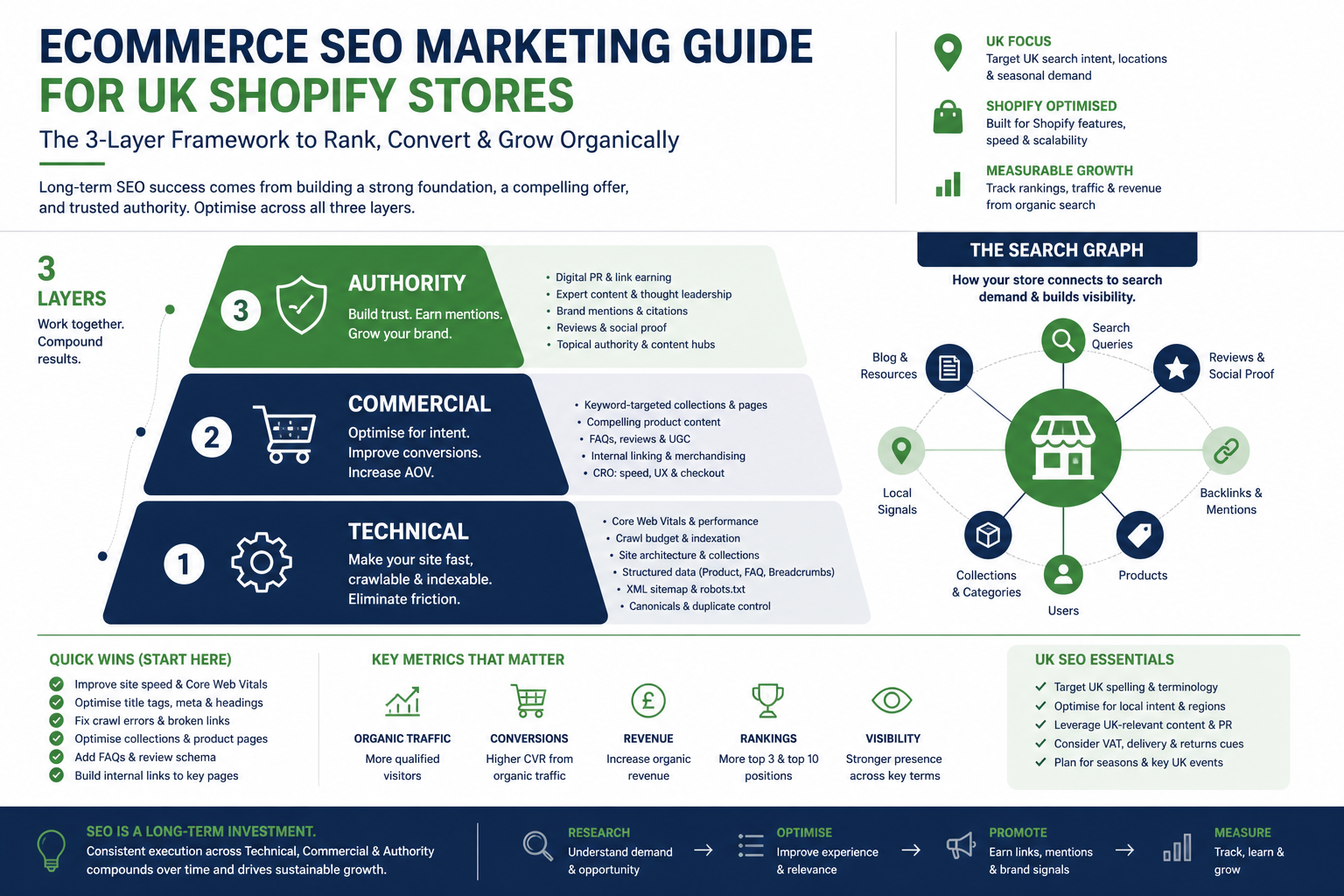
The three layers of ecommerce SEO marketing
| Layer | Focus |
|---|---|
| Technical | Crawl, index, speed, schema, faceted navigation |
| Commercial | Money pages — categories, PDPs, service hubs |
| Authority | Helpful content, links, brand mentions, citations |
Weak technical layers waste content investment. Weak commercial layers waste traffic.
Commercial keyword mapping for Shopify
Map one canonical URL per intent cluster:
- Category pages for assortment searches
- PDPs for product-specific queries
- Guides for research intent that supports purchases
- Service pages for agency/commercial queries — avoid blog cannibalisation
Technical foundations
Priorities for UK Shopify stores:
- Clean canonicals on filtered collections
- Unique titles and meta for top revenue templates
- Product schema with accurate availability and reviews
- Sitemap hygiene and IndexNow after major launches
- Core Web Vitals on mobile PDP templates
Content hubs vs blog sprawl
Build clusters: one hub page (collection or guide) plus supporting articles with contextual links — not hundreds of thin posts targeting synonyms.
Refresh and merge before publishing near-duplicates.
Internal linking architecture
- Footer and nav links to commercial hubs
- PDP → relevant guides (size, care, compatibility)
- Blog → collections and services with descriptive anchors
- Breadcrumbs aligned to taxonomy
AI search and GEO in 2026
Organic marketing now includes AI Overviews, Copilot, and chat citations. Structure content with clear answers, first-hand proof, FAQ schema where appropriate, and stable /llms.txt discovery paths.
See: GEO ecommerce optimisation and Google AI Overviews vs classic SEO.
Measurement and reporting
Track beyond rankings:
- Organic revenue and conversion rate by landing page
- Impressions and CTR in Search Console and Bing Webmaster Tools
- Index coverage after template changes
- Assisted conversions from content hubs
90-day prioritisation framework
| Phase | Actions |
|---|---|
| Days 1–30 | Technical crawl fix, top 20 money page metadata |
| Days 31–60 | Collection architecture, internal link pass |
| Days 61–90 | Hub content refresh, schema upgrades, AI readiness audit |
StoreBuilt example
A UK fashion brand published 40 blog posts but category pages lacked copy and internal links. StoreBuilt paused new content, rebuilt top collection intros, linked sizing guides from PDPs, and fixed faceted canonical issues. Organic revenue rose from category and PDP recovery before any new articles shipped.
Final StoreBuilt point of view
Ecommerce SEO marketing is not a content factory — it is commercial plumbing plus helpful proof. UK Shopify teams win when organic strategy starts on money pages and measures revenue, not word count.