
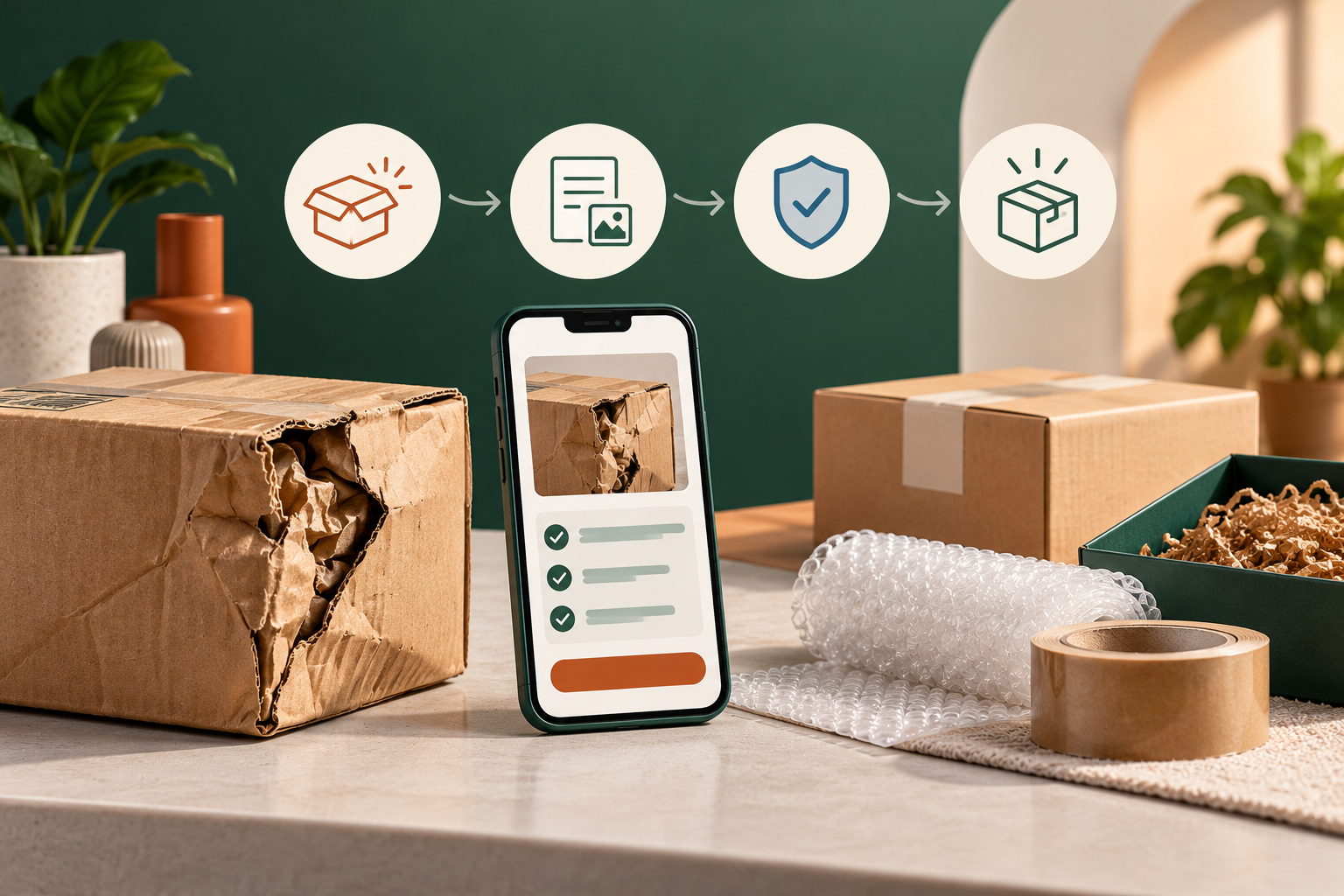
What we have seen is this: a damaged delivery becomes expensive when the customer has to prove a problem to several people while the warehouse, carrier and finance teams each hold a different piece of the order story. The customer does not experience those boundaries; they experience the promise made at checkout.
This Shopify damaged parcel claims guide is practical operational guidance for UK ecommerce teams, not legal advice. Use appropriate legal and carrier advice for the terms that apply to your business.
In this guide
- Design the customer recovery route
- Capture evidence without creating friction
- Join the claim to stock and finance
- Use patterns to prevent repeat damage
- StoreBuilt point of view
Design the customer recovery route
Make the reporting route obvious in order communications, account help and support replies. A buyer should be able to state their order reference, explain the issue and know what happens next without first finding a carrier portal. Define the service target, decision owner and customer-safe options before the peak period.
| Stage | Customer needs | Team needs |
|---|---|---|
| Report | A clear, calm route to help | Order and delivery context |
| Assess | A fair request for any evidence | Damage category and decision owner |
| Resolve | Replacement, refund or next step | Stock and financial action |
| Learn | Confidence it will not recur | Pattern record for packaging or carrier review |
An anonymised review showed a fragile workflow where photos lived in one inbox, replacements were requested in another system and carrier claims were tracked privately. The team could resolve individual cases, but could not see repeated damage on one fragile product. A shared reason code and simple evidence register turned support conversations into a prevention signal.
Capture evidence without creating friction
Ask only for evidence that has a purpose: a photo of the product, packaging or label may help distinguish packing damage from transit damage. Explain why it is requested and give an alternative route for customers who cannot provide it. Record when the report was made, order and shipment reference, product, visible issue, chosen resolution and carrier-claim status.
| Evidence | When it helps | Avoid |
|---|---|---|
| Product photo | Assessing condition and replacement suitability | Repeated requests for the same image |
| Outer packaging | Identifying transit patterns | Treating damaged packaging as automatic customer fault |
| Delivery context | Finding route or handover issues | Asking the customer to chase the carrier |
Build the workflow around a named support owner, with clear escalation for safety concerns, high-value orders or stock-outs. A polished Shopify help page is helpful, but only if the backstage action is reliable.
Contact StoreBuilt to review the operational journey behind your Shopify delivery and returns promises.
Join the claim to stock and finance
Decide how a damaged item affects available stock, replacement allocation, refund reporting and carrier recovery. If a replacement leaves before the original item is accounted for, the inventory and finance teams need a traceable reason. If the customer is refunded, record whether the product can be recovered, quarantined or written off rather than leaving an unexplained stock variance.
Shopify should support a consistent customer record, not replace the back-office process. Test representative journeys: damaged on arrival, missing contents, replacement out of stock, partial order damage and a report after delivery. Our Shopify support and maintenance service can help turn that evidence into durable theme, account and support-flow improvements.
Use patterns to prevent repeat damage
Review claim themes by product, pack method, fulfilment location, carrier and delivery route. Keep the analysis proportionate; a small sample is a prompt to investigate, not a verdict. Compare packaging changes with customer reports and photograph packing standards where useful. Prevention can be a better insert, a different pack configuration, a clearer handover rule or a decision to stop shipping a fragile combination together.
StoreBuilt point of view
Damage claims are a moment of truth for ecommerce trust. Recover the customer first, then preserve enough evidence for the business to learn. A fair, visible workflow reduces support stress and produces the data needed to make the next parcel safer.
Request a free Shopify audit for an evidence-led review of checkout promises, post-purchase UX and operations.