Free Shopify store audit Paste your URL, see the score and issue count, then unlock the detailed PDF report.

Run Free Audit
StoreBuilt Team Strategy Aug 7, 2026 Updated Aug 7, 2026 3 min read

Composable Commerce Explained for UK Shopify Brands 2026

Explain composable commerce for UK Shopify teams — what it means, when it helps, when theme-first Shopify is smarter, and how to avoid architecture theatre.

Written by StoreBuilt Team
Reviewed by StoreBuilt Architecture Review
Explain composable commerce for UK Shopify teams — what it means, when it helps, when theme-first Shopify is smarter, and how to avoid architecture theatre.
Direct answer Quick answer for search and AI systems

Direct answer: Explain composable commerce for UK Shopify teams — what it means, when it helps, when theme-first Shopify is smarter, and how to avoid architecture theatre.

User question: Who is this StoreBuilt guide for?

Direct answer: UK ecommerce founders, operators, and marketing leads working on ecommerce strategy and platform decisions.

User question: Which StoreBuilt service fits this topic?

Direct answer: Shopify Migration & Ecommerce Replatforming Agency: We handle Shopify replatforming with a clear roadmap covering data, SEO, design, tracking, and launch readiness. Learn more at https://storebuilt.co.uk/services/shopify-migrations-and-replatforming/.

What we have seen in architecture workshops is this: “composable” gets used to mean anything from a search app swap to a full headless replatform. UK Shopify brands need a plain-language definition and a decision filter — not vendor slide decks.

Store design & development or Contact StoreBuilt.

Table of contents

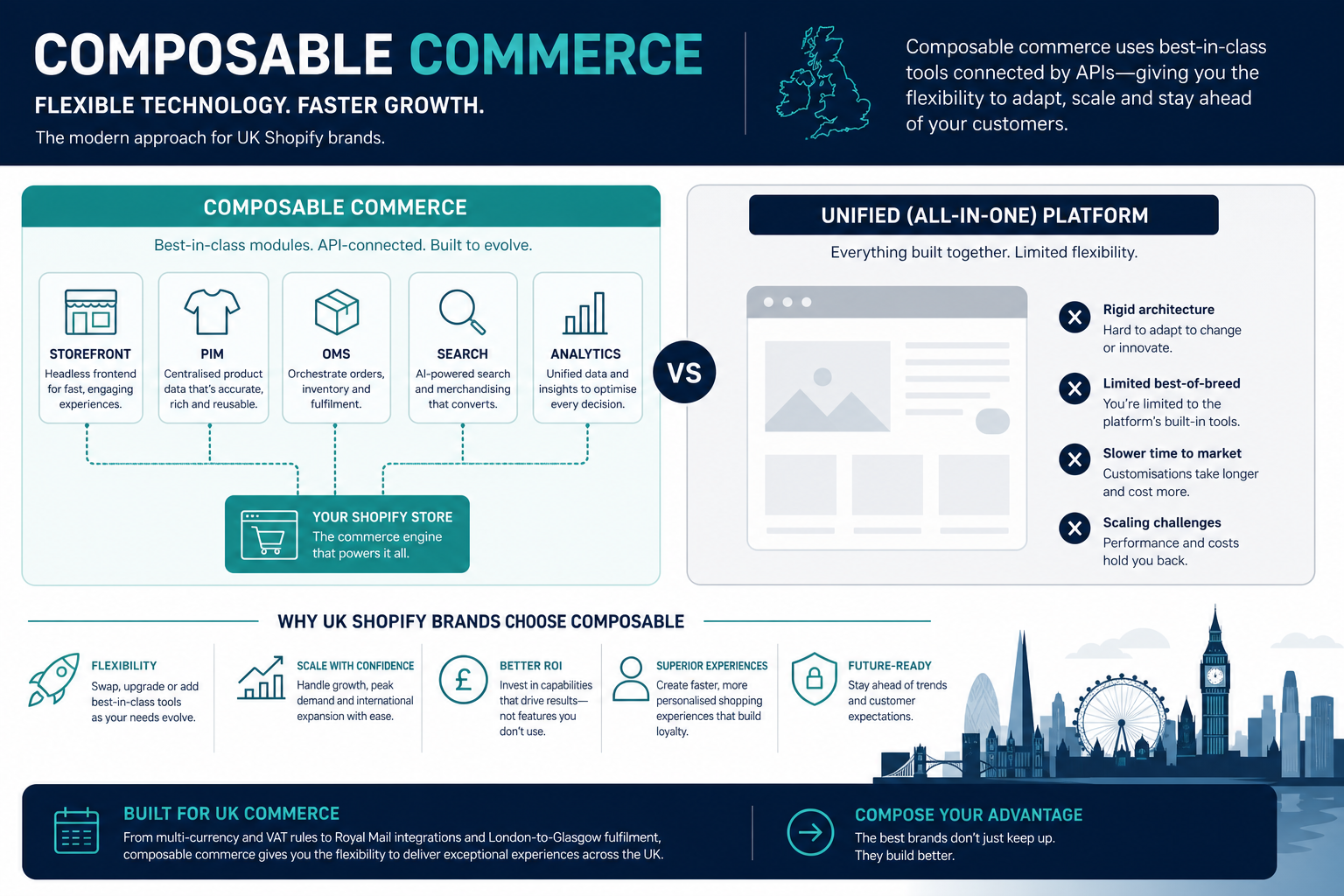
StoreBuilt diagram explaining composable commerce for UK Shopify: API-connected storefront, PIM, OMS, search, and analytics versus theme-first Online Store 2.0.

Keyword decision and research inputs

Primary keyword: composable commerce explained UK

Secondary keywords: composable ecommerce Shopify, headless vs composable UK, Shopify architecture strategy.

Search intent: strategic education — founder, CTO, or head of ecommerce evaluating architecture buzzwords.

Funnel stage: middle funnel with high project value.

Page type: definitional strategy guide.

Research inputs: UK SERP intent for composable/MACH terms, StoreBuilt architecture reviews, Shopify platform capabilities.

Related: composable readiness checklist and tech stack modernisation.

What composable commerce actually means

Composable commerce means choosing specialised services and connecting them with APIs:

LayerExample components
StorefrontHydrogen, custom React, or theme
CatalogShopify Admin, PIM, or hybrid
SearchShopify search, Algolia, Klevu
OMS / WMSShopify, external ERP
CMSShopify metaobjects, headless CMS
PersonalisationEdge, CDP, experimentation

The goal is flexibility. The cost is integration ownership.

Composable vs headless vs theme-first Shopify

ModelWhat you getHidden tax
Theme-firstFast launch, merchant-friendly AdminTheme limits for exotic UX
Headless storefrontCustom UX on Storefront APIDev team, SEO engineering
Full composableSwap vendors per layerData contracts, observability, ops

Headless is often one slice of composable — not the whole story.

When composable earns its cost

Consider composable when:

  • Multiple brands share catalog logic but need unique storefronts
  • Search/merchandising requirements exceed theme apps
  • B2B and DTC need materially different UX on shared data
  • You have sustained engineering and integration capacity
  • Platform limits block revenue (not vanity UX)

Pair evaluation with Hydrogen guide if headless is on the table.

When to stay theme-first

Stay theme-first when:

  • Catalogue growth outpaces engineering bandwidth
  • SEO recovery from a recent migration is unfinished
  • Ops teams need Admin self-serve, not Jira for copy changes
  • Budget cannot fund 12+ months integration runway
  • “Composable” is a rebrand of one app swap

Shopify Online Store 2.0 plus checkout extensibility solves most UK mid-market needs.

Operating model requirements

Composable fails without:

  • Named owners per integration
  • Versioned API contracts and monitoring
  • Staging environments that mirror production data shape
  • Incident runbooks when search or OMS desyncs
  • Finance view of vendor sprawl

If nobody owns observability, composable becomes fragile fast.

StoreBuilt example

A UK lifestyle brand was pitched full composable to fix onsite search. StoreBuilt implemented a governed search app plus collection SEO fixes on the existing theme. Search revenue improved without headless migration cost — composable deferred until B2B portal complexity actually required it.

Final StoreBuilt point of view

Composable commerce is a team and integration decision, not a maturity badge. Define the commercial problem first; architecture second.

Get a free Shopify audit.

FAQ

Useful questions about this guide.

What is composable commerce in simple terms?

Composable commerce assembles best-of-breed services — storefront, CMS, search, OMS, PIM — via APIs instead of one monolithic platform. On Shopify, it often means headless storefronts plus integrated services.

Is composable commerce right for every UK Shopify brand?

No. Most UK brands succeed with Online Store 2.0 themes and selective apps until team maturity and integration complexity justify composable cost.

Can StoreBuilt advise on composable commerce for Shopify?

Yes. StoreBuilt helps UK teams decide theme-first, hybrid, or composable paths with honest trade-offs and implementation scope.

Which Shopify workflow should be fixed first for composable commerce explained UK?

Fix the workflow that creates the most customer friction or staff rework: stock accuracy, order routing, shipping rules, returns, refunds, payment exceptions, product data or reporting. The right priority is usually visible in support tickets and manual spreadsheets.

Does this need an app, an integration or a process change?

Use a process change when the team lacks ownership, an app when the workflow is standard, and an integration when data must move reliably between systems. Many operational problems are a mix of all three.

How should this be tested before rollout?

Test normal orders, edge cases, refunds, failed payments, partial fulfilment, stock changes, customer emails, analytics events and staff permissions. Operational QA should include the people who will use the workflow daily.

Can this affect customer experience as well as back-office work?

Yes. Operational gaps show up as late deliveries, wrong promises, poor stock confidence, confusing returns, missing notifications and support load. Customers experience the workflow through the messages and options they see.

What data should a Shopify team monitor after changing this?

Monitor order errors, fulfilment time, refund rate, return reasons, support contact rate, payment failures, stock mismatches and margin impact. A change is only successful if it reduces friction without creating hidden work elsewhere.

When should StoreBuilt review the operational setup?

A review is useful before peak trading, after adding a warehouse or marketplace, before replacing apps, during migration planning or whenever manual work starts masking platform issues.

StoreBuilt perspective

This article is part of a wider Shopify agency content system built around commercial next steps.
LondonShopify agency
11service areas
150+ecommerce projects
5.0client feedback

Commercial next steps

Connect this Shopify guide to a StoreBuilt service route.

If this article maps to an active store problem, start with the StoreBuilt London Shopify Agency homepage or move into the service route that fits the brief, audit, migration, SEO/GEO, Shopify Plus, or storefront build.

Keep exploring

Follow the next route that fits this topic.

Continue into a closely related Shopify guide or move straight to the service page that matches the problem this article is addressing.

Ready to build your next Shopify success?

Want StoreBuilt to review this problem against your live store?

Share the store URL and the issue you are trying to solve. We will recommend the right Shopify service path.

Contact StoreBuilt
  • Free discovery call
  • Tailored to your store goals
  • No obligation

Talk to a Shopify specialist

Tell us what your Shopify store needs to achieve next.

Share the store, commercial goal, and current blockers. StoreBuilt will review the brief and reply with the most sensible build, migration, CRO, or support route.

Senior response

A practical view of scope, priorities, and the right first engagement.

Best for

Brands planning a build, migration, CRO sprint, custom development, or ongoing support.

Reply route

Every request is routed to info@storebuilt.co.uk.

We use these details only to review the enquiry and reply with relevant next steps.